Khóa học
IELTS Online
IELTS Online
Giảm đến 18%
Đăng ký ngay
Mục lục [Ẩn]
Bài đọc Otter là một trong những bài kiểm tra toàn diện nhất về kỹ năng Reading IELTS, mang tính học thuật cao. Bài viết này sẽ cung cấp hướng dẫn giải chi tiết từng câu, từ những câu hỏi True/False/Not Given hóc búa đến các dạng Matching phức tạp, giúp bạn ôn luyện Skill Reading hiệu quả và nâng cao band điểm của mình.
| Bạn đang ở band IELTS bao nhiêu? Làm bài test miễn phí và nhận ngay lộ trình học cá nhân hóa. 👉 Đăng ký test IELTS miễn phí ngay |
Otters
A
Otters have long, thin bodies and short legs – ideal for pushing through dense undergrowth or hunting in tunnels. An adult male may be up to 4 feet long and 30lbs. Females are smaller typically. The Eurasian otter’s nose is about the smallest among the otter species and has a characteristic shape described as a shallow ‘W’. An otters tail (or rudder, or stern) is stout at the base and tapers towards the tip where it flattens. This forms part of the propulsion unit when swimming fast underwater. Otter fur consists of two types of hair: stout guard hairs which form a waterproof outer covering, and under-fur which is dense and fine, equivalent to an otter’s thermal underwear. The fur must be kept in good condition by grooming. Seawater reduces the waterproofing and insulating qualities of otter fur when saltwater in the fur. This is why freshwater pools are important to otters living on the coast. After swimming, they wash the salts off in pools and the squirm on the ground to rub dry against vegetation.
B
The scent is used for hunting on land, for communication and for detecting danger. Otterine sense of smell is likely to be similar in sensitivity to dogs. Otters have small eyes and are probably short-sighted on land. But they do have the ability to modify the shape of the lens in the eye to make it more spherical, and hence overcome the refraction of water. In clear water and good light, otters can hunt fish by sight. The otter’s eyes and nostrils are placed high on its head so that it can see and breathe even when the rest of the body is submerged. Underwater, the cotter holds its legs against the body, except for steering, and the hind end of the body is flexed in a series of vertical undulations. River otters have webbing which extends for much of the length of each digit, though not to the very end. Giant otters and sea otters have even more prominent webs, while the Asian short-clawed otter has no webbing – they hunt for shrimps in ditches and paddy fields so they don’t need the swimming speed. Otter’s ears are tiny for streamlining, but they still have very sensitive hearing and are protected by valves which close them against water pressure.
C
A number of constraints and preferences limit suitable habitats of otters. Water is a must and the rivers must be large enough to support a healthy population of fish. Being such shy and wary creatures, they will prefer territories where man’s activities do not impinge greatly. Of course, there must also be no other otter already in residence – this has only become significant again recently as populations start to recover. Coastal otters have a much more abundant food supply and range for males and females may be just a few kilometres of coastline. Because male range overlaps with two or three females – not bad! Otters will eat anything that they can get hold of – there are records of sparrows and snakes and slugs being gobbled. Apart from fish, the most common prey are crayfish, crabs and water birds. Small mammals are occasionally taken, most commonly rabbits but sometimes even moles.
D
Eurasian otters will breed any time where food is readily available. In places where the condition is more severe, Sweden for example where the lakes are frozen for much of winter, cubs are born in spring. This ensures that they are well grown before severe weather returns. In the Shetlands, cubs are born in summer when fish is more abundant. Though otters can breed every year, some do not. Again, this depends on food availability. Other factors such as food range and quality of the female may have an effect. Gestation for Eurasian otter is 63 days, with the exception of Lutra canadensis whose embryos may undergo delayed implantation. Otters normally give birth in more secure dens to avoid disturbances. Nests are lined with bedding to keep the cub’s warm mummy is away feeding.
E
Otters normally give birth in more secure dens to avoid disturbances. Nests are lined with bedding (reeds, waterside plants, grass) to keep the cub’s warm while is away feeding. Litter Size varies between 1 and 5. For some unknown reason, coastal otters tend to produce smaller litters. At five weeks they open their eyes – a tiny cub of 700g. At seven weeks they’re weaned onto solid food. At ten weeks they leave the nest, blinking into daylight for the first time. After three months they finally meet the water and learn to swim. After eight months they are hunting, though the mother still provides a lot of food herself. Finally, after nine months she can chase them all away with a clear conscience, and relax – until the next fella shows up.
F
The plight of the British otter was recognised in the early 60s, but it wasn’t until the late 70s that the chief cause was discovered. Pesticides, such as dieldrin and aldrin, were first used in1955 in agriculture and other industries – these chemicals are very persistent and had already been recognised as the cause of huge declines in the population of peregrine falcons, sparrow hawks and other predators. The pesticides entered the river systems and the food chain – micro-organisms, fish and finally otters, with every step increasing the concentration of the chemicals. From 1962 the chemicals were phased out, but while some species recovered quickly, otter numbers did not – and continued to fall into the 80s. This was probably due mainly to habitat destruction and road deaths. Acting on populations fragmented by the sudden decimation in the 50s and 60s, the loss of just a handful of otters in one area can make an entire population unviable and spell the end.
G
Otter numbers are recovering all around Britain – populations are growing again in the few areas where they had remained and have expanded from those areas into the rest of the country. This is almost entirely due to legislation, conservation efforts, slowing down and reversing the destruction of suitable otter habitat and reintroductions from captive breeding programs. Releasing captive-bred otters is seen by many as a last resort. The argument runs that where there is no suitable habitat for them they will not survive after release and where there is suitable habitat, natural populations should be able to expand into the area. However, reintroducing animals into a fragmented and fragile population may add just enough impetus for it to stabilise and expand, rather than die out. This is what the Otter Trust accomplished in Norfolk, where the otter population may have been as low as twenty animals at the beginning of the 1980s. The Otter Trust has now finished its captive breeding program entirely, great news because it means it is no longer needed.
Questions 1-9
The reading Passage has seven paragraphs A-G
Which paragraph contains the following information?
Write the correct letter A-G, in boxes 1-9 on your answer sheet.
NB You may use any letter more than once.
1. A description of how otters regulate vision underwater
2. The fit-for-purpose characteristics of otter’s body shape
3. A reference to an underdeveloped sense
4. An explanation of why agriculture failed in otter conservation efforts
5. A description of some of the otter’s social characteristics
6. A description of how baby otters grow
7. The conflicting opinions on how to preserve
8. A reference to the legislative act
9. An explanation of how otters compensate for heat loss
Questions 10-13
Answer the questions below.
Choose NO MORE THAN THREE WORDS AND/OR A NUMBER from the passage for each answer
10. What affects the outer fur of otters?
11. What skill is not necessary for Asian short-clawed otters?
12. Which type of otters has the shortest range?
13. Which type of animals do otters hunt occasionally?
>>> Xem thêm: Những sai lầm khi luyện IELTS Reading cần tránh và cách khắc phục
|
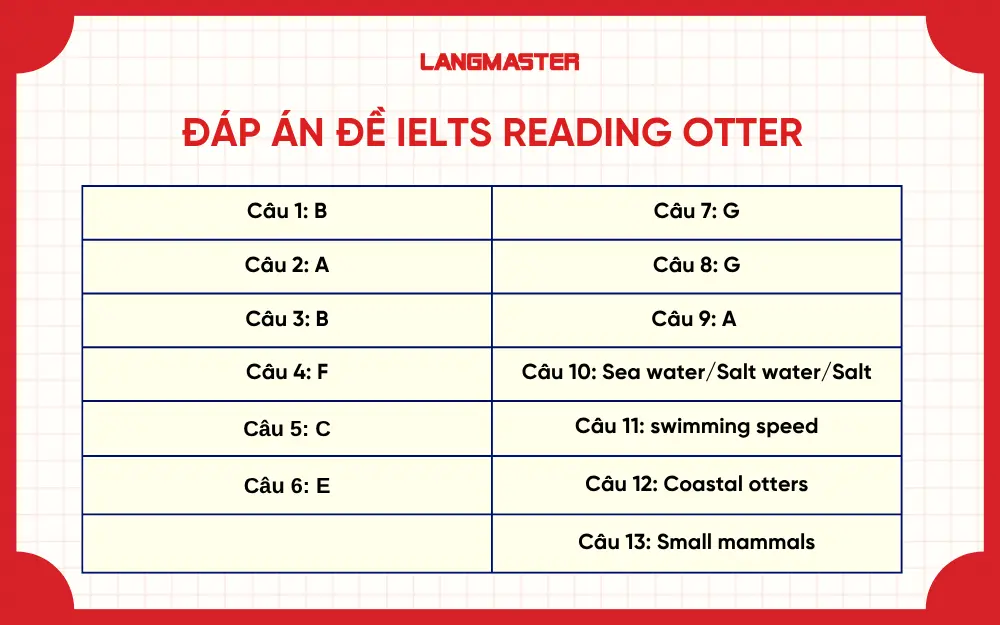
Câu 1: B |
Câu 7: G |
|
Câu 2: A |
Câu 8: G |
|
Câu 3: B |
Câu 9: A |
|
Câu 4: F |
Câu 10: Sea water/Salt water/Salt |
|
Câu 5: C |
Câu 11: swimming speed |
|
Câu 6: E |
Câu 12: Coastal otters |
|
Câu 13: Small mammals |
Giải thích chi tiết:
Question 1 – Answer: B
Answer location: Paragraph B, line 3
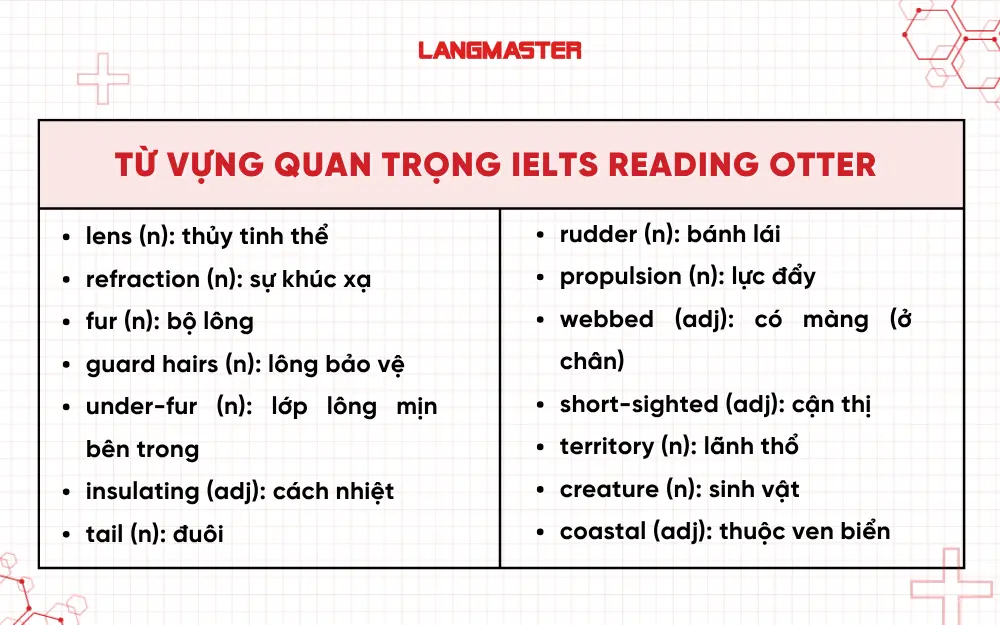
Thông tin trong bài: “they do have the ability to modify the shape of the lens in the eye to make it more spherical, and hence overcome the refraction of water.” (Rái cá có khả năng điều chỉnh hình dạng thủy tinh thể trong mắt để nhìn rõ dưới nước, giúp chúng khắc phục hiện tượng khúc xạ ánh sáng)
→ Chi tiết này cho thấy rái cá có thể điều chỉnh mắt để nhìn rõ dưới nước, khắc phục hiện tượng khúc xạ ánh sáng → Đáp án B
Question 2 – Answer: A
Answer location: Paragraph A, line 4
Thông tin trong bài: “an otter’s tail is stout at the base and tapers towards the tip where it flattens. This forms part of the propulsion unit when swimming fast underwater.” (đuôi của rái cá dày ở gốc, mảnh dần và dẹt ở cuối, giúp nó bơi nhanh hơn dưới nước. Cấu trúc cơ thể này thể hiện sự thích nghi hoàn hảo với môi trường sống)
→ Chi tiết này cho thấy cấu tạo cơ thể, đặc biệt là phần đuôi, được thiết kế để giúp rái cá di chuyển hiệu quả dưới nước → Đáp án A
Question 3 – Answer: B
Answer location: Paragraph B, line 2
Thông tin trong bài: “Otters have small eyes and are probably short-sighted on land.” (Rái cá có mắt nhỏ và bị cận khi ở trên cạn, nghĩa là thị giác của chúng kém phát triển
→ Điều này cho thấy rái cá có thị lực kém khi ở trên cạn, thể hiện một giác quan chưa phát triển hoàn thiện → Đáp án B.
Question 4 – Answer: F
Answer location: Paragraph F, line 5
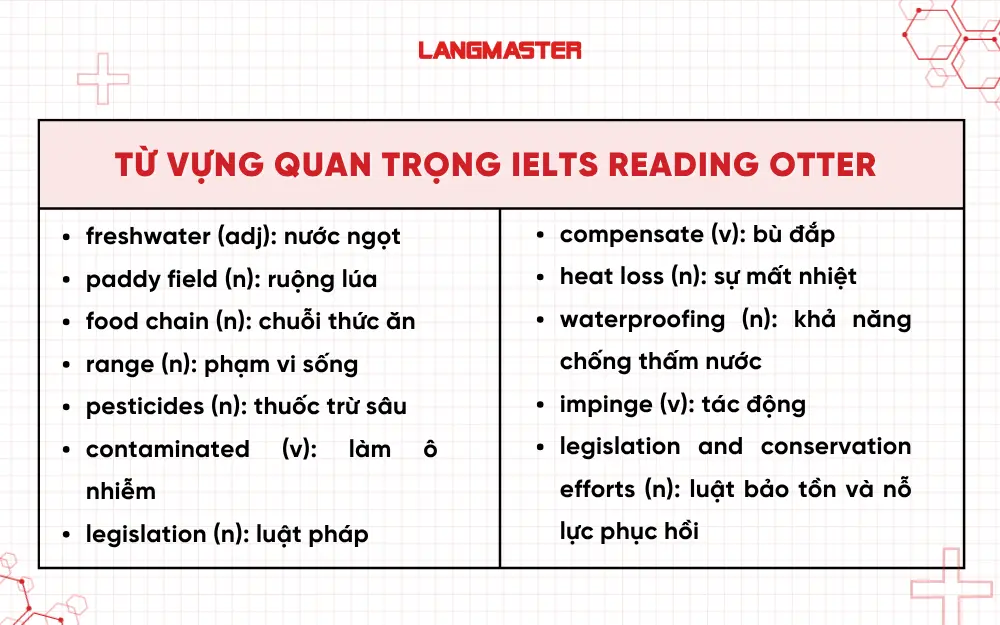
Thông tin trong bài: “Pesticides entered the river systems and the food chain – micro-organisms, fish and finally otters.” (Thuốc trừ sâu từ nông nghiệp ngấm vào hệ thống sông và chuỗi thức ăn, gây suy giảm số lượng rái cá)
→ Điều này giải thích vì sao hoạt động nông nghiệp thất bại trong công tác bảo tồn, do hóa chất độc hại làm ô nhiễm sông ngòi và ảnh hưởng đến rái cá. → Đáp án là F.
Question 5 – Answer: C
Answer location: Paragraph C, line 2
Thông tin trong bài: “being such shy and wary creatures, they will prefer territories where man’s activities do not impinge greatly.” (Rái cá thường sống ở nơi ít có hoạt động của con người, thể hiện đặc điểm xã hội nhút nhát và sống tách biệt)
→ Câu này mô tả hành vi sống của rái cá – chúng thích những khu vực yên tĩnh, tránh xa con người. → Đáp án là C.
>> Xem thêm: Giải đề IELTS Reading: How deserts are formed [Full answers]
Question 6 – Answer: E
Answer location: Paragraph E, line 4
Thông tin trong bài: “At five weeks they open their eyes… At seven weeks they’re weaned onto solid food… After eight months they are hunting.” (Rái cá con phát triển qua nhiều giai đoạn: mở mắt, tập ăn, học bơi và săn mồi, cho thấy quá trình trưởng thành của chúng)
→ Nội dung này mô tả quá trình phát triển của rái cá con từ khi mở mắt, tập ăn, tập bơi đến khi biết săn mồi. → Đáp án là E.
Question 7 – Answer: G
Answer location: Paragraph G, line 5
Thông tin trong bài: “some believe reintroducing captive-bred otters is a last resort, while others argue it helps stabilize fragile populations.” (Có người cho rằng thả rái cá nuôi sinh sản là biện pháp cuối cùng, nhưng người khác lại tin rằng điều này giúp duy trì và phục hồi quần thể yếu)
→ Chi tiết này thể hiện hai luồng quan điểm trái ngược trong việc bảo tồn rái cá. → Đáp án là G.
Question 8 – Answer: G
Answer location: Paragraph G, line 3
Thông tin trong bài: “This is almost entirely due to legislation, conservation efforts, and reversing habitat destruction.” (Rái cá phục hồi chủ yếu nhờ luật bảo tồn và các biện pháp phục hồi môi trường sống)
→ Từ “legislation” cho thấy vai trò của các chính sách và luật bảo vệ động vật → Đáp án là G.
Question 9 – Answer: A
Answer location: Paragraph A, line 6
Thông tin trong bài: “Otter fur consists of two types of hair: stout guard hairs forming a waterproof outer covering, and under-fur providing insulation.” (Lông rái cá có lớp ngoài chống nước và lớp trong giữ nhiệt, giúp chúng thích nghi với việc sống dưới nước
–> Hai lớp lông giúp rái cá giữ nhiệt và tránh mất nhiệt trong môi trường lạnh. → Đáp án là A.
Question 10 – Answer: sea water / salt water / salt
Answer location: Paragraph A, line 8
Thông tin trong bài: “Seawater reduces the waterproofing and insulating qualities of otter fur when saltwater in the fur.” (Nước biển hoặc muối ảnh hưởng đến lớp lông ngoài của rái cá, khiến khả năng giữ ấm giảm)
→ Nước muối làm giảm khả năng cách nhiệt và chống thấm của bộ lông. → Đáp án là sea water / salt water / salt.
| Bạn đang ở band IELTS bao nhiêu? Làm bài test miễn phí và nhận ngay lộ trình học cá nhân hóa. 👉 Đăng ký test IELTS miễn phí ngay |
>> Xem thêm: Giải đề IELTS Reading Left or Right [FULL ANSWER]
Question 11 – Answer: swimming speed
Answer location: Paragraph B, line 9
Thông tin trong bài: “The Asian short-clawed otter has no webbing – they hunt for shrimps in ditches and paddy fields so they don’t need the swimming speed.” (Vì săn tôm ở ruộng và mương, rái cá vuốt ngắn châu Á không cần tốc độ bơi nhanh)
→ Rái cá vuốt ngắn châu Á không cần tốc độ bơi nhanh vì sống ở vùng nước nông. → Đáp án là swimming speed.
Question 12 – Answer: coastal otters
Answer location: Paragraph C, line 5
Thông tin trong bài: “Coastal otters have a much more abundant food supply and range for males and females may be just a few kilometres of coastline.” (Do nguồn thức ăn dồi dào, rái cá sống ven biển chỉ cần di chuyển trong phạm vi vài km)
→ Điều này chứng tỏ rái cá vùng ven biển có phạm vi sinh sống ngắn nhất. → Đáp án là coastal otters.
Question 13 – Answer: small mammals
Answer location: Paragraph C, last line
Thông tin trong bài: “Small mammals are occasionally taken, most commonly rabbits but sometimes even moles.” (Rái cá đôi khi săn các động vật nhỏ như thỏ hoặc chuột chũi)
→ Chi tiết này cho thấy rái cá thỉnh thoảng săn các động vật có vú nhỏ. → Đáp án là small mammals.
>> Xem thêm:
>> Xem thêm: Thời gian làm Reading IELTS: Chiến lược phân bổ và mẹo làm bài hiệu quả
Để đạt điểm cao trong IELTS Reading nói riêng và overall nó chung, điều quan trọng là học theo một lộ trình khoa học, có sự kèm cặp của giảng viên và nhận được phản hồi cụ thể cho từng bài làm. Đây cũng chính là lý do nhiều bạn tin tưởng lựa chọn khóa học IELTS online tại Langmaster – nơi mang đến cho học viên những trải nghiệm học tập vượt trội:

Ưu đãi đặc biệt – HỌC THỬ MIỄN PHÍ: Giúp bạn trải nghiệm phương pháp giảng dạy và cảm nhận sự khác biệt ngay từ buổi học đầu tiên.
KẾT LUẬN: Như vậy, chúng ta đã vừa cùng nhau phân tích và giải chi tiết đề IELTS Reading chủ đề Otter. Bài viết đã làm rõ các kỹ năng cần thiết để tìm thông tin, nhận biết từ khóa và áp dụng chiến lược đọc hiểu hiệu quả. Hy vọng hướng dẫn này sẽ giúp bạn tự tin hơn khi làm bài và cải thiện điểm số Reading IELTS. Chúc bạn học tập hiệu quả và đạt kết quả cao trong kỳ thi IELTS sắp tới!

Các dạng bài phổ biến và tiêu chí chấm điểm IELTS Reading chi tiết nhất: Multiple Choice, Matching Information, Matching Headings,... và hướng dẫn chiến lược làm bài hiệu quả
Những sai lầm khi luyện IELTS Reading bao gồm: dịch từng từ, đọc hết cả bài, không đọc câu hỏi trước, không quản lý thời gian, không nắm vững kỹ năng paraphrase, viết sai chính tả
![Giải đề IELTS Reading: A brief history of humans and food [full answers]](https://langmaster.edu.vn/storage/images/2025/09/20/a-brief-history-of-humans-and-food-ielts-reading-answers.webp)
Giải đề thi IELTS Reading “A brief history of humans and food” kèm full đề thi thật, câu hỏi, đáp án, giải thích chi tiết, và từ vựng cần lưu ý khi làm bài.
Tổng hợp IELTS Reading tips hay nhất giúp bạn đọc nhanh, nắm ý chính và xử lý thông tin chính xác, tự tin đạt điểm cao trong kỳ thi IELTS.
![Giải đề IELTS Reading: The importance of law [Full answers]](https://langmaster.edu.vn/storage/images/2025/09/22/55.webp)
Giải đề IELTS Reading “The importance of law” kèm đáp án chi tiết, từ vựng quan trọng và bí quyết luyện thi hiệu quả để nâng cao band điểm.



Hơn 16 năm kinh nghiệm, đào tạo thành công 800.000+ học viên
Phương pháp giảng dạy hiện đại, học viên tiến bộ rõ rệt
Lộ trình học chuẩn quốc tế, phù hợp với nhu cầu thực tiễn
Giáo viên đạt chuẩn Quốc tế với chất lượng top đầu thị trường, giàu kinh nghiệm
Học online linh hoạt, cam kết đầu ra bằng văn bản

![Giải đề thi IELTS Reading: Listening to the Ocean [Full Answer]](https://langmaster.edu.vn/storage/uploads/original/2025/10/13/listening-to-the-ocean-ielts-reading-2.png)
.png)
![Giải đề IELTS Reading: The Voynich Manuscript [Full answers]](https://langmaster.edu.vn/storage/uploads/original/2025/10/15/voynich-manuscript-ielts-reading.png)